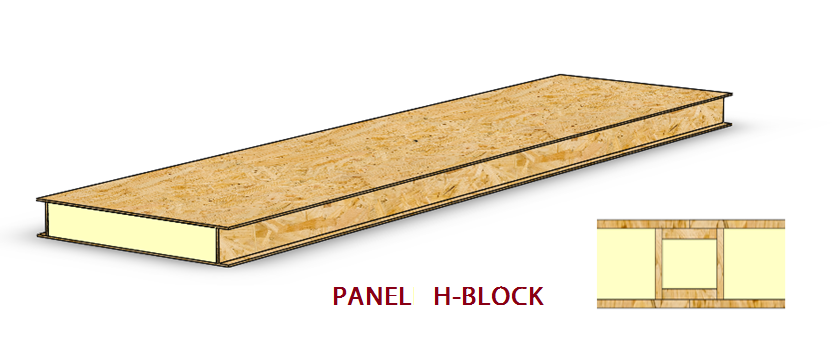
Panel SIP panelowi H-Block nie równy !

Panel SIP panelowi H-Block nie równy 
…. i to pod wieloma względami ‼️

Dlaczego❓

✔️ H-Block jest płytą o konstrukcji skrzynkowej z OSB wypełnionej spienionym poliuretanem. SIP to przyklejona do rdzenia styropianowego płyta OSB będąca osłoną, czasami wykorzystywana jako element nośny.
✔️ H-Block tworzy jednolitą strukturę izolacyjno-konstrukcyjną poprzez zespolenie okładzin OSB z poliuretanem. Wypełniający skrzynkę płyty H-Block poliuretan, pod bardzo wysokim ciśnieniem zespaja się z OSB tworząc jednolity materiał.
SIP jest natomiast pięciowarstwowym elementem, w którym okładziny OSB sklejane są z rdzeniem styropianowym. Jakość „konstrukcyjna” SIP jest wprost zależna od jakości kleju, sposobu jego nakładania oraz sposobu przyklejenia. 
✔️ H-Block ma średnią gęstość izolacji 42 kg/m3 zaś SIP 20-30 kg/m3. To powoduje, że H-Block jest znacznie bardziej odporny na zniszczenie. Przy takiej samej grubości rdzenia, H-Block ma też dużo większą izolacyjność cieplną (50-70%). 
✔️ H-Block – dzięki środnikom – może być używany jako strop czy dach, bez dodatkowej konstrukcji (w zależności od rozpiętości). SIP nie nadaje się do zastosowania na stropy czy dachy bez dodatkowej konstrukcji. 
✔️ H-Block – dzięki konstrukcyjności – ogranicza do minimum zastosowanie drewnianej konstrukcji nośnej budynku. SIP nie jest konstrukcyjny i wymaga drewnianej konstrukcji nośnej podnosząc koszty inwestycji. Dotyczy to w szczególności dachów, gdzie SIP musi być układany na konstrukcji (bez mostka cieplnego) lub jako wypełnienie belek (z mostkiem cieplnym). 
✔️ H-Block ma w standardzie okładziny z OSB grubości 15 mm. SIP ma najczęściej grubość 12 mm. 
✔️ H-Block jest produkowany w długościach do 13 m. SIP nie może być dłuższy jak 3 m.
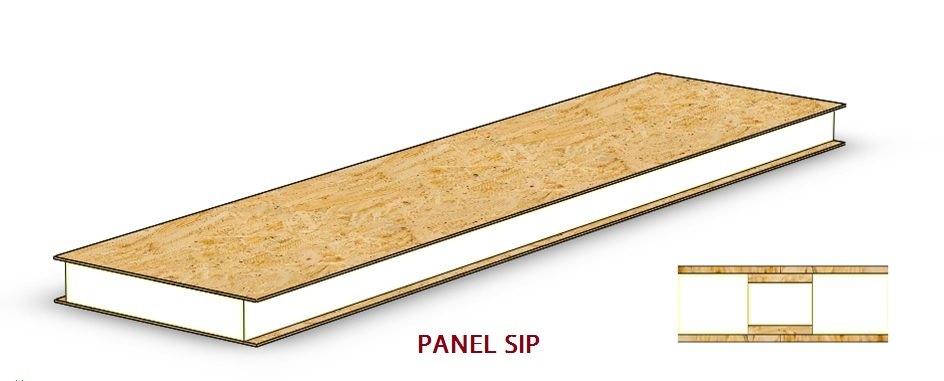
SIP panel is not equal to H-Block !

SIP panel is not equal to H-Block…
…. and this in many respects ‼️

Why❓

✔️ H-Block is a panel with box structure made of OSB filled with foamed polyurethane. SIP is an OSB panel glued to the polystyrene core, which is a shield, sometimes is used as a supporting element.
✔️ H-Block creates a homogeneous insulating and constructional structure by joining OSB linings with polyurethane.

The polyurethane filling the box of the H-Block panel, under very high pressure, is bonded to the OSB to form a homogeneous material.

SIP is a five-layer element in which OSB linings are glued together with a Styrofoam core.

The “constructional” quality of SIP is directly dependent on the quality of the glue, the method of its application and the method of sticking.
✔️ H-Block has an average insulation density of 42 kg / m3 and SIP 20-30 kg / m3. This causes that H-Block is much more resistant to destruction.

With the same core thickness, H-Block also has much higher thermal insulation (50-70%).
✔️ H-Block – thanks to the webs – can be used as a ceiling or roof, without additional construction (depending on the span).

SIP is not suitable for use on ceilings or roofs without additional construction.
✔️ H-Block – thanks to its construction – minimizes the use of the wooden load bearing structure of the building.

SIP is not structural and requires a wooden load bearing structure raising investment costs.

This applies in particular to roofs, where SIP must be laid on a structure (without thermal bridge) or as a filling of beams (with thermal bridge).
✔️ H-Block has standard OSB linings with a thickness of 15 mm. SIP usually has a thickness of 12 mm.
✔️ H-Block is produced in lengths of up to 13 m. SIP may not be longer than 3 m.